


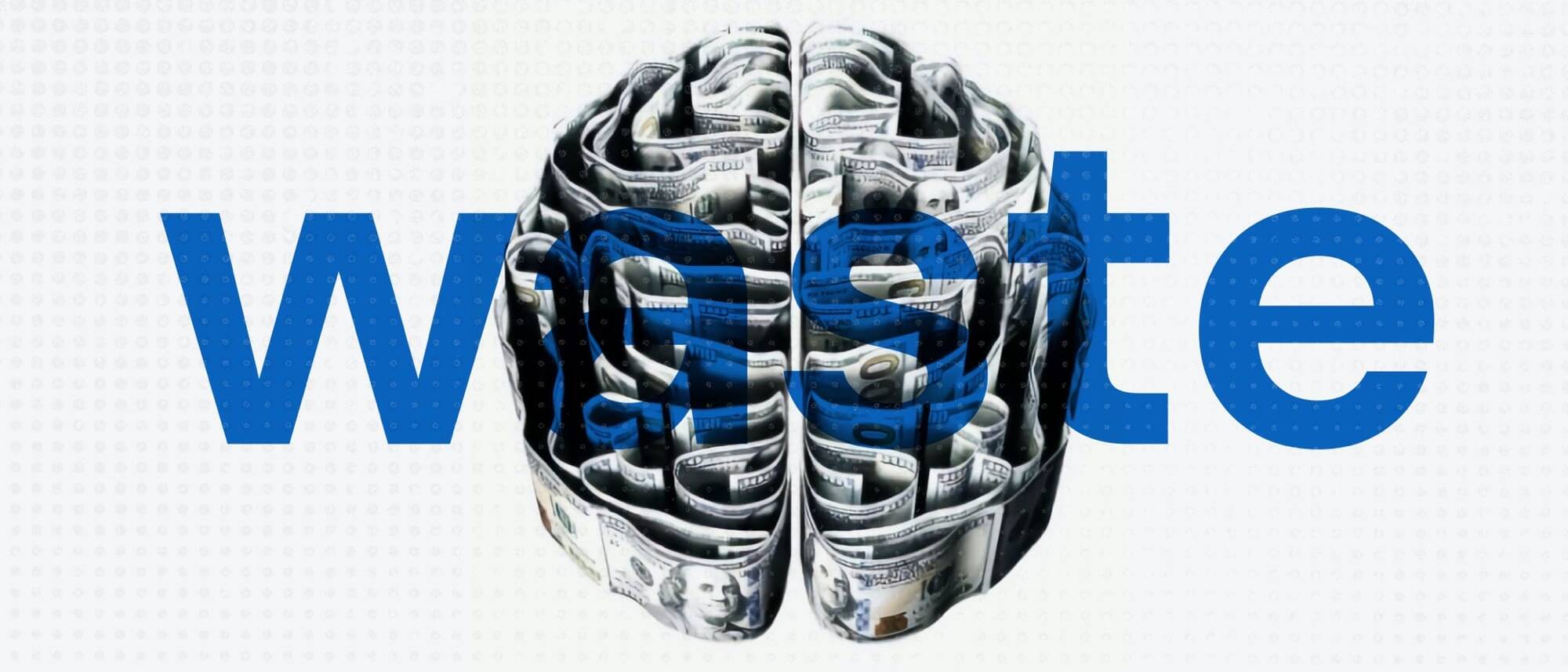
Every year enormous sums of money are spent on marketing products and services.

https://www.statista.com/statistics/236943/global-advertising-spending/
Due to the obfuscation or confusion of clear goals most companies are unsure of the return on investment they are getting from their marketing budget. Google and Facebook will gladly take your money in exchange for vanity metrics like impressions or views. That is because almost all companies involved in marketing, from graphic design agencies to ad facilitators like Google, Snapchat, Twitter and Facebook and even old-school channels like magazines and newspapers have a vested interest in making sure the metrics that actually matter are not measured. It’s an entire industry built on hypothetical “brand recognition” that doesn’t bring in sales. Views and engagements are measured and “institutional advertising” flourishes without bringing a return on investment.
In effect you are up against a whole industry built around sustaining the “building awareness” and “getting impressions” myth. The truth is that most marketing doesn’t work, it might feel good to get thousands of impressions or build your brand, but in many cases it doesn’t actually drive sales.
Evidence that “digital marketing” can be a complete waste
In the summer of 2017 Procter & Gamble, at the time the world’s largest advertiser in the world with brands such as Ariel, Pampers, Braun, Old Spice sent shockwaves through the marketing industry. After cutting more than $100 million in digital marketing spend in the previous quarter the company saw little impact on its business. Some of the ineffectiveness was attributed to bots clicking ads and fake traffic. The news was a huge wakeup call to companies worldwide and was the first time digital ads were proven to be largely ineffective on such a massive scale. Procter & Gamble’s chief executive said: “We want every dollar to add value for the consumer or add value for our stakeholders.” and “What it reflected was a choice to cut spending from a digital standpoint where it was ineffective.”

https://adage.com/article/news/global-marketers-2018-tktk/315743/
Evidence that marketing can be the single most important growth factor
How did we arrive at this point in time? How can the world’s biggest advertiser cut $100 million from their digital ad budget and have it barely have an impact? Is all marketing a waste of money?
The answer is “No”. Let’s look at a few companies built on marketing:
De Beers diamonds
Diamonds are not actually rare, and contrary to what the industry would have you believe, they hold no intrinsic value as for example gold or silver.
In 1888 huge diamond reserves were discovered in South Africa. The chairman of De Beers, Sir Ernest Oppenheimer, foresaw that the oversupply of diamonds would saturate the market and eventually drive the price down. By an amazing feat Ernest managed to control the world’s diamond trade and restrict the flow of diamonds to the world. There was only one problem: there was no real market demand.
Engagement rings were not widely adopted before the second world war and so Ernest turned to marketing to create that demand by hiring the agency N.W. Ayer. The agency’s game plan was simple: to create a situation where almost every person pledging marriage feels compelled to acquire a diamond engagement ring.
Using the celebrity influencers of the time and radio and TV ads with the AdAge #1 slogan of the century, the agency managed to increase the rate of diamond sales 55% in the first four years from 1938-1941 and between 1939 and 1979 sales increased from $23 million to $2.1 billion.
So marketing actually built a strong foundation for the $72 billion-per-year diamond industry and had one company dominating it for a good 80 years.

HubSpot
The quintessential modern software company.
HubSpot is a marketing company and we are about to get really meta here. HubSpot invented the term “Inbound marketing” to mean drawing customers to you via social media, content marketing etc. HubSpot’s rocket growth makes them the second fastest growing small and medium business software company ever according to Forbes. They credit content with pulling down CAC, which allowed them to offer lower prices for their software, grow market share and fend off the competition. In other words, by creating content that genuinely creates new knowledge for the reader, they built what they call “inbound marketing.”
HubSpot proved to the public markets that content marketing could be an incredible engine for massive valuations. Their “Inbound” niche is so much wider than simply saying “we do marketing.” They essentially carved out a new market segment, and the content they produce drives leads at a huge scale. There is nothing more impactful than defining the category you operate in.
Your table stakes channels
Before experimenting, master the two channels that repeatedly top ROI reports.
- Still the #1 digital channel for ROI (DMA Response Rate Report).
- Automation and segmentation let you scale personalization.
- Caveat: be ruthless about value or subscribers will churn.
Content
- Proof of expertise and a magnet for backlinks, search rankings, and press.
- Acts as the “free sample” of the transformation you sell.
- Prioritize depth and originality over volume.
Finding your unique growth levers
Once the foundation is in place, begin structured testing.
- Audit competitors. What channels earn their attention? Which gaps can you own?
- Interview customers. Ask where they discover new tools, who they trust, and how they decide.
- Run small bets. Launch controlled experiments with clear success criteria.
- Double down. Scale the channels that deliver provable revenue.
The goal is to build a stack of repeatable plays, not chase every new platform.
Final thoughts
Marketing isn’t doomed—but it is often mismanaged. Focus budgets on channels where you can measure cause and effect, use content and email as your baseline, and treat experimentation as a disciplined process. The right mix can manufacture demand (De Beers), create categories (HubSpot), and outmaneuver incumbents.
Are there any examples of unconventional marketing strategies you have seen work in the wild? Anything we have missed? If so we would love to hear about them in the comments below!